Free summer programs for high school students: The four categories families should understand
Many families search for “free summer programs,” but that phrase hides an important truth: not all free programs are free in the same way. Some programs cover tuition, housing, meals, and activities for every admitted student. Others have a high sticker price but offer enough need-based aid to make attendance free. Some are tuition-free but still require families to handle travel, meals, commuting, or housing. Others are free virtual or local programs that remove travel costs but may offer a different kind of experience.
That distinction matters. A student comparing RSI, TASS, SSP, PROMYS, YYGS, Rockefeller SSRP, Clark Scholars, MITES, SAMS, Simons, JCamp, Girls Who Code, and Kode With Klossy is not just comparing prestige. They are comparing funding models, access barriers, program outputs, and application strategy.
The most useful question is not simply, “Is this program free?” It is: What exactly is free, for whom, and what costs remain?
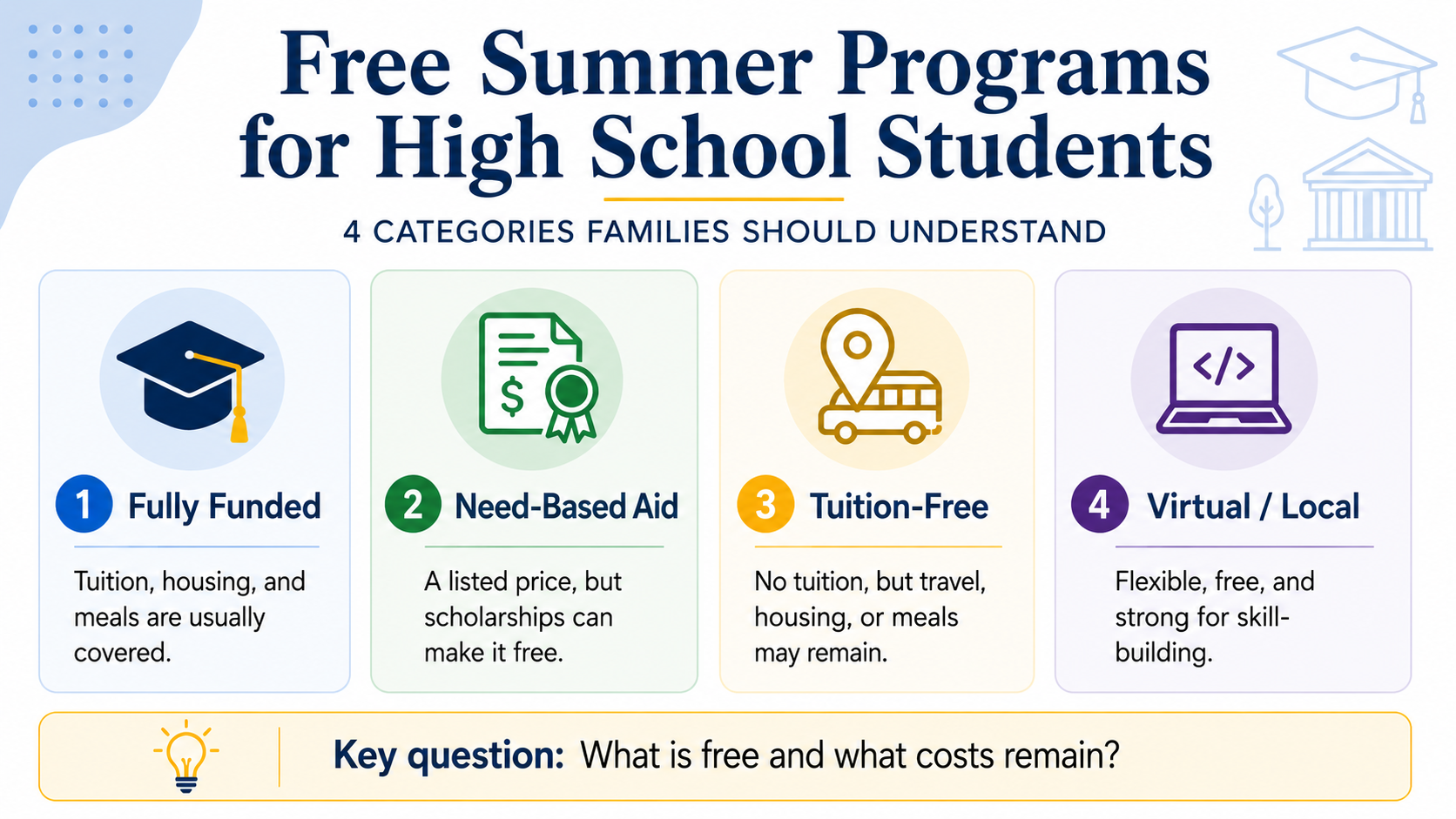
The four major categories
| Category | What it means | Main advantage | Main caution |
|---|---|---|---|
| 1. Fully funded for every admitted student | Core costs are covered automatically once admitted. | No separate financial-aid uncertainty for tuition, room, or board. | Travel, personal expenses, or application fees may still remain. |
| 2. Need-based aid can make the program free | The program has a sticker price, but admitted students may receive full aid. | Families should not self-select out because of price. | Aid forms, deadlines, and travel policies matter. |
| 3. Tuition-free but logistics-dependent | No tuition or program fee, but students may need to cover commuting, meals, housing, or travel. | Strong academic access without tuition cost. | “Free tuition” may still be impossible without local housing or transportation. |
| 4. Free virtual, local, or skill-building programs | Programs are free and often easier to access geographically. | Lower travel burden and good portfolio-building opportunities. | They may not offer the same residential, lab, or seminar immersion as selective campus programs. |
These categories are not rankings. A fully funded residential program is not automatically better than a free virtual coding program. The right category depends on the student’s goals, family logistics, location, academic readiness, and summer constraints.
Category 1: Fully funded for every admitted student
This is the cleanest version of “free.” In this category, a student does not need to prove financial need to avoid tuition or housing costs. The program is designed so that admitted students can participate regardless of family income.
Examples include RSI, TASS, MITES Summer, Carnegie Mellon SAMS, Clark Scholars, JCamp, and Princeton Summer Journalism Program.
Research Science Institute (RSI) is one of the clearest examples in STEM: the Center for Excellence in Education describes RSI as cost-free to students, and its academic program materials state that invited students receive free tuition, room, and board, with transportation to and from MIT as the primary student expense. (RSI)
Telluride Association Summer Seminar (TASS) is the humanities and social-science counterpart in this category. Telluride Association says TASS covers tuition, books, room and board, field trips, and facilities fees for every student, and students with need may request help with travel costs or lost summer earnings. (Telluride Association)
MITES Summer, a six-week residential STEM program for rising seniors, also fits this model. MITES states that its programs are free of cost to students and that educational, food, and boarding costs are covered, while students generally pay for transportation to and from MIT; travel scholarships are available for MITES Summer students. (MITES)
Carnegie Mellon’s SAMS is similarly structured. CMU describes SAMS as a fully funded, merit-based program with no cost to scholars beyond travel to and from Pittsburgh. (Carnegie Mellon University)
Clark Scholars is another strong example, but it shows why families still need to read the fine print. Texas Tech states that Clark Scholars has no program participation fees and provides on-campus meals, room and board, and weekend programming. However, students are still responsible for a $25 application fee, travel, personal expenses, and medical expenses; students receive a $750 stipend after completing a successful research project report. (Texas Tech University)
Journalism programs can also fall into the fully funded category. JCamp covers all costs, including airfare, lodging, and meals, and has no application fee. (AAJA) Princeton Summer Journalism Program is a free year-long journalism and college-preparation program for high school juniors from limited-income backgrounds. (Princeton Summer Journalism Program)
What makes this category different
The defining feature is that admission itself unlocks the funding. Families do not need to wonder whether aid will be enough to make the program possible, although they still need to check travel, application fees, and personal expenses.
These programs are often highly selective because the program, not the student, is absorbing most of the cost. That means students should treat the application less like a registration form and more like a competitive scholarship application.
Best fit: Students with strong academic or creative depth who can show clear intellectual fit, initiative, and readiness for an intense community.
Category 2: Need-based aid can make the program free
This is the most misunderstood category. These programs may look expensive at first, but they can be free or nearly free for students with demonstrated financial need. Families should not reject them based only on sticker price.
Examples include SSP, PROMYS, and YYGS.
Summer Science Program (SSP) has a substantial listed program fee, but its aid policy is unusually strong. The Summer Science Program states that financial need is not considered in admissions and that it commits to covering 100% of demonstrated need for admitted students, including possible round-trip airfare and other travel support. SSP also notes that students from families under about $100,000 in household income will likely qualify for free attendance plus travel expenses, while no one pays more than the 2026 program fee of $11,800. (Summer Science Program)
Program in Mathematics for Young Scientists (PROMYS) works differently. It is free, including tuition, room, and board, for domestic students whose families make under $80,000 in adjusted gross income, and demonstrated-need awards can cover up to the full cost of participation. PROMYS also says some travel support may be available. (PROMYS)
YYGS is a classic “high sticker price, meaningful aid” program. Yale lists the 2026 residential tuition as $7,000 for one two-week session, with tuition covering on-campus components such as housing, meals, and curriculum materials, but not travel. YYGS offers need-based financial aid up to the full cost of tuition for domestic and international students, and some scholarships cover full tuition and sometimes travel. (Yale Young Global Scholars)
What makes this category different
In this category, “free” is conditional. The program may be free for a particular student, but not automatically free for every admitted student.
The key difference is administrative: students must complete financial aid materials correctly and on time. YYGS, for example, requires students seeking aid to complete the financial-aid portion within the original application; there are no later opportunities after admissions decisions to request aid. (YYGS Financial Aid)
These programs are especially important because families often self-select out too early. A student may see a $7,000 or $11,800 price tag and assume the program is only for wealthy families, even though the official aid policy may make attendance possible.
Best fit: Students who are strong enough to be competitive and whose families are willing to complete financial-aid documentation carefully.
Category 3: Tuition-free but logistics-dependent
This category is where many families get surprised. A program may be academically excellent and genuinely tuition-free, but still difficult to attend because housing, meals, commuting, or travel are not fully covered.
Examples include Rockefeller SSRP, Simons Summer Research Program, Stanford SIMR, and Notre Dame Leadership Seminars.
Rockefeller’s SSRP is free to apply to and free to participate in. Rockefeller also provides an OMNY card for NYC public transit and may offer need-based stipends for additional program-related travel expenses. But Rockefeller does not provide or help students find accommodations in New York City, which makes the program much easier for students who can commute or arrange housing independently. (Rockefeller University SSRP FAQ)
Simons Summer Research Program at Stony Brook has no tuition charges or fees, but admitted students are responsible for transportation and dining costs if commuting, or residential costs if living on campus. (Stony Brook University)
Stanford Institutes of Medicine Summer Research Program (SIMR) states that there is no cost for selected students to participate, but stipends are limited and based on need. (Stanford Medicine SIMR) For students who do not live near Stanford or cannot solve summer housing logistics, “no cost to participate” may still leave a real access gap.
Notre Dame Leadership Seminars sits on the edge of this category. Notre Dame pays tuition, housing, and meals for admitted students, but students are responsible for a $75 application fee, a $150 enrollment fee, and travel to and from the university; fee waivers and travel aid are rare and limited to extreme circumstances. (Notre Dame Pre-College Programs)
What makes this category different
The defining question is not “Is tuition free?” but “Can the student physically and financially get there every day?”
This category often includes serious research internships and campus programs, which can be excellent for students who live nearby or can arrange transportation and housing. But it can be less accessible for students who would need to relocate, pay for meals, or give up summer work income.
Best fit: Students near the program location, students with family housing options nearby, or students whose families can manage travel and living logistics even if tuition is free.
Category 4: Free virtual, local, or skill-building programs
This category is different from the others because the value is usually not residential immersion or elite research placement. Instead, the value is access: students can learn, build projects, join a community, and explore a field without the cost or logistics of traveling to a campus. These programs are generally more accessible and focus on skill-building rather than selective research placement.
Examples include Girls Who Code Pathways and Kode With Klossy.
Girls Who Code Pathways is a free program for high school girls and non-binary students. It offers tracks in game design, data science, artificial intelligence, cybersecurity, and web development, and the program is fully virtual. (Girls Who Code)
Kode With Klossy offers free two-week coding-intensive camps for young women and gender-expansive teens ages 13–18. Camps are offered virtually and in selected in-person locations, and no prior coding experience is required. (Kode With Klossy)
What makes this category different
These programs usually have a lower logistical barrier. Students do not need to pay for a dorm, fly across the country, or spend six weeks away from home. They can also be strong options for students who are newer to a field and want to build a first serious project.
The tradeoff is that free virtual or local programs may not carry the same intensity as a residential research institute. But that does not make them less valuable. For many students, especially those early in coding, data science, AI, journalism, or civic work, a free skill-building program can produce something concrete: a website, app, article, portfolio, presentation, or clearer academic direction.
Best fit: Students seeking access, flexibility, portfolio projects, field exploration, or a first structured experience.
The most important differences between the categories
1. “Free for everyone” vs. “free if you qualify”
Fully funded programs like TASS, MITES, SAMS, Clark Scholars, and JCamp generally cover major costs for every admitted student. Need-based aid programs like SSP, PROMYS, and YYGS require a second layer of financial evaluation. Both can be excellent, but families should understand whether funding is automatic or conditional.
2. Tuition coverage vs. total cost of attendance
A program can be tuition-free and still expensive in practice. Rockefeller SSRP and Simons show this clearly: both remove tuition as a barrier, but housing, commuting, dining, or location can still determine whether a student can realistically attend. (Rockefeller University SSRP FAQ)
3. Residential immersion vs. flexible access
RSI, TASS, MITES, SAMS, SSP, PROMYS, Clark Scholars, and YYGS are immersive residential or campus-based experiences. Girls Who Code and Kode With Klossy are more flexible and access-oriented. The first model may offer deeper community and mentorship; the second may be easier to fit around family responsibilities, jobs, caregiving, or local commitments.
4. Research output vs. skill-building output
Research programs usually ask students to produce a paper, poster, presentation, or final report. Seminar programs often emphasize discussion, writing, and intellectual community. Coding programs may produce portfolio projects. Journalism programs may produce articles, multimedia work, or college advising outcomes. The best program is the one whose output matches the student’s next step.
5. Selectivity vs. accessibility
Fully funded residential programs are often extremely selective because seats are limited and costs are subsidized. Free virtual and local programs may be more accessible and scalable. A smart summer plan should include both ambitious reaches and realistic access options.
Free summer programs for high school students: The four categories families should understand
How students should build a balanced summer list
A strong list should include more than one funding category.
A STEM research student might apply to RSI, SSP, Clark Scholars, Rockefeller SSRP, MITES, SAMS, SIMR, and Simons, while also keeping a local lab, community college course, or free coding program as a practical option.
A humanities, journalism, or civic-minded student might prioritize TASS, YYGS, Princeton Summer Journalism Program, JCamp, and Notre Dame Leadership Seminars, while also looking for local reporting, debate, public policy, library, nonprofit, or writing opportunities.
A student newer to computer science might use Girls Who Code or Kode With Klossy to build skills before applying to more selective research or engineering programs later.
The goal is not to create the longest list. The goal is to create a list with different risk profiles: some highly selective fully funded programs, some need-based aid programs, some local or tuition-free opportunities, and at least one accessible option that the student would genuinely use well.
Families should evaluate every program with five questions:
-
What is automatically covered?
Tuition, housing, meals, materials, field trips, and activities are separate cost categories. -
What is not covered?
Travel, commuting, housing, application fees, enrollment fees, meals, medical expenses, and personal expenses can matter. -
Is financial aid automatic, need-based, or unavailable?
A fully funded program and a program with full-need aid are both valuable, but they require different planning. -
Does the student need to be local?
A tuition-free commuter research program may be ideal for a nearby student and unrealistic for a student across the country. -
What will the student produce or gain?
A research poster, proof-based math experience, published journalism, coding portfolio, seminar writing, or college advising may each serve different goals.
Bottom line
The best way to understand free summer programs is by category.
Fully funded programs remove most core costs for every admitted student. Need-based aid programs may look expensive but can become free for students who qualify. Tuition-free programs can be academically powerful but still require careful attention to housing, travel, and meals. Free virtual or local programs may be less flashy, but they can offer real access, skill development, and portfolio-building without major logistical barriers.
For students, the smartest strategy is not to chase the most famous program. It is to understand the funding model, compare the real cost of attendance, and choose opportunities where the student can do serious work without creating unnecessary financial strain.