We would like to use cookies to see how the site is used and to record errors so we can fix them. If you decline, the site works the same and both stay switched off. Read our Privacy Policy
The Rise of AI in Business Majors Across the U.S. — Vantion Insights
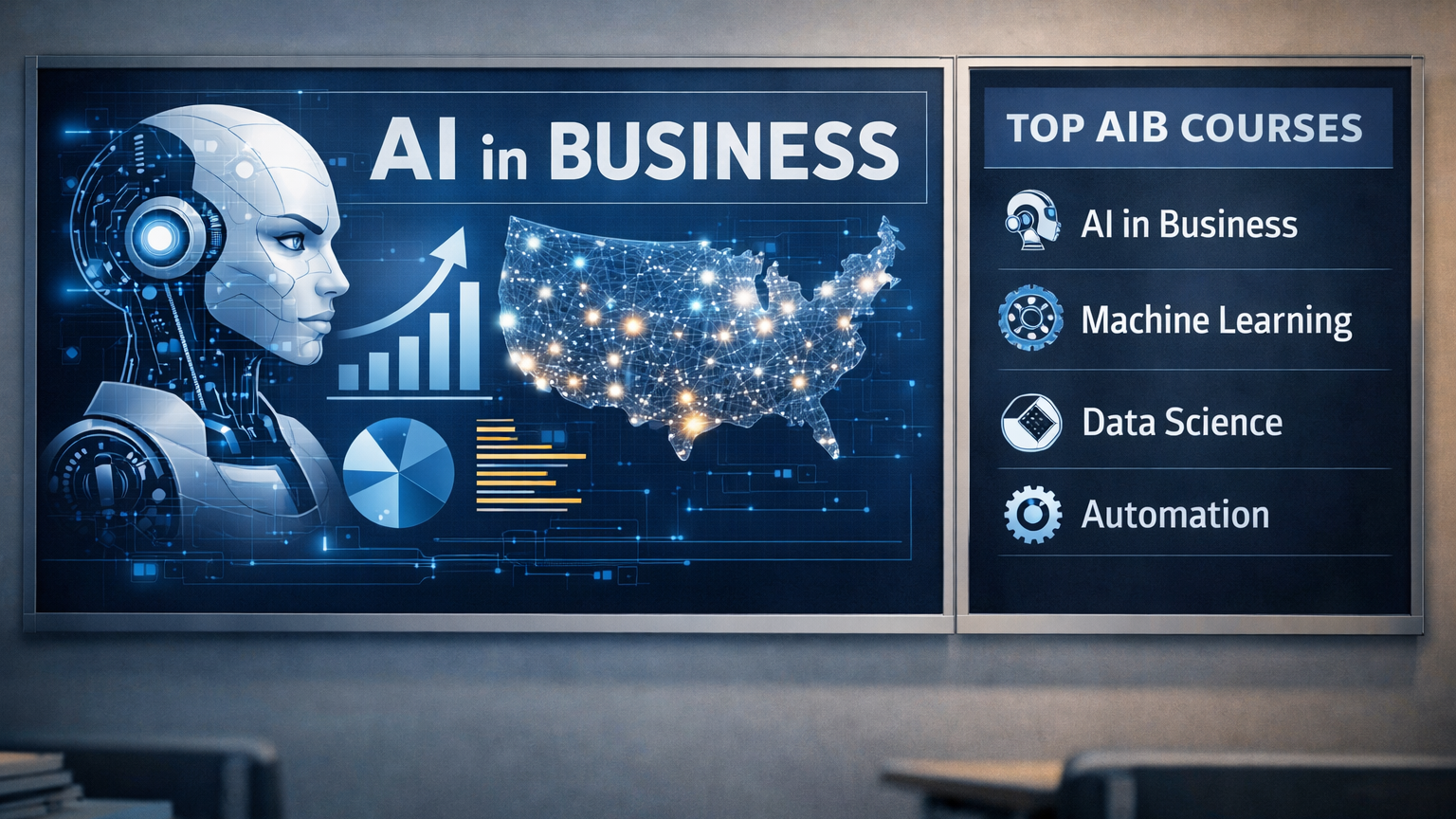
Artificial intelligence is no longer a niche add-on in business education. Across the U.S., universities are moving beyond a handful of analytics electives and starting to formalize AI as a distinct part of the undergraduate business curriculum. What began as exposure to data science or business intelligence is becoming something more defined: full business degrees with AI built into the core, joint business-engineering programs, and specialized concentrations that train students to use AI strategically, responsibly, and at scale.
This shift reflects a broader change in employer demand. Businesses are not only looking for software engineers and data scientists. They also need managers, analysts, consultants, and operators who understand how AI works, where it creates value, how to govern it responsibly, and how to translate between technical teams and business decision-makers. In that sense, the rise of AI in business majors is not simply a curriculum trend. It signals the emergence of a new type of business graduate: one who can combine commercial judgment with AI fluency.
A useful way to understand this landscape is to organize programs into four categories: full degrees, joint programs, concentrations, and certificates. Together, these models show how schools are approaching the same challenge from different directions.
1. Full degrees: AI as a standalone business major
The clearest sign of momentum is the growth of full undergraduate degrees that explicitly combine business education with AI. These programs treat AI not as an elective specialty but as a core domain of managerial preparation.
At Arizona State University, the BS in Artificial Intelligence in Business represents one of the most scalable models in the country. The degree is structured around applying AI to business operations and decision-making, with an emphasis on practical adoption and responsible use. What makes ASU notable is not only the curriculum itself, but also its accessibility. The program is available in multiple formats, including online, which suggests that AI-in-business education is moving from elite experimentation toward broader market availability.
At the University of South Florida, the shows how business schools are pairing AI with analytical rigor. Rather than separating AI from the analytics tradition, USF integrates the two, preparing students to work with predictive tools, data-driven strategy, and organizational decision systems. Its broader curriculum redesign also signals something important: schools increasingly view AI literacy as a foundational competency for all business students, not only those in specialist tracks.
A third strong example is NJIT’s BS in Business with AI, which gives the full-degree model a more technical infrastructure orientation. The program emphasizes AI applications in strategy and operations while benefiting from an institution with strong engineering and computing capabilities. That makes it especially relevant for students who want a business degree with heavier exposure to technical systems and innovation ecosystems.
These full-degree programs matter because they move AI from the margins of business education into the center of it. They signal to employers that graduates were trained from day one to think about AI not just as a tool, but as part of modern business architecture.
2. Joint programs: business education built with engineering
A second category includes joint programs that combine business-school training with engineering or computer science. These are often among the most distinctive offerings because they are intentionally designed at the intersection of managerial and technical education.
The strongest example is the University of Southern California’s BS in Artificial Intelligence for Business, offered jointly by USC Marshall and USC Viterbi. This is not a traditional business major with a few technical electives appended. It is a fully integrated degree that combines business fundamentals with AI, computation, and sector-specific applications. USC also stands out for its purpose-built integrative courses on digital transformation, technology strategy, and industry use cases. The result is a program designed for students who want to lead in AI-enabled enterprises without choosing between business and engineering identities.
Joint models are powerful because they address one of the biggest workforce gaps in AI adoption: translation. Many companies struggle not because they lack technical talent, but because they lack people who can connect technical possibilities to business priorities. Programs like USC’s are built precisely to produce those translators.
This category may remain smaller than full business degrees, since it requires significant cross-school coordination, but it is likely to have outsized influence. Joint programs often become the prototype for how universities think about interdisciplinary AI education more broadly.
3. Concentrations: AI embedded within established business degrees
The third category is the concentration model, where students major in a broader business field but specialize in AI through a formal track. This approach may prove especially influential because it allows established business schools to move quickly without redesigning the entire undergraduate degree structure.
A leading example is Wharton’s Artificial Intelligence for Business concentration at the University of Pennsylvania. Wharton’s advantage is not just prestige; it is the sophistication of the curriculum design. The concentration explicitly combines technical methods with ethical and societal impact, reflecting a maturing view of AI education. Students are expected to learn how AI can be applied in business, but also how it should be governed. That balance between capability and responsibility is becoming a defining feature of top-tier programs.
Concentrations are likely to remain a popular model because they fit naturally into the structure of undergraduate business education. They allow schools to preserve traditional business breadth while giving students credible depth in AI. For many institutions, this is the fastest route to relevance.
4. Certificates: flexible pathways for AI business literacy
A fourth category is the certificate model, which gives students a shorter, more flexible way to build AI fluency within or alongside a business education. Certificates are especially important because they allow universities to expand AI access beyond full majors and to serve students who want targeted preparation without committing to a full degree redesign.
One strong example is the University of Georgia’s Undergraduate Certificate in Artificial Intelligence for Business, which is designed to give Terry College students a foundation in AI techniques for contemporary business problems while also emphasizing communication, evaluation of AI systems, and ethical and societal implications.
Another example is the University of Pittsburgh’s Undergraduate Certificate in Foundations of AI for Business, which combines required coursework with electives spanning responsible AI, fintech, IT platforms, consulting, design thinking, and technical AI topics such as deep learning and human language technologies.
Certificates may become one of the fastest-growing formats in this space because they are adaptable, stackable, and easier for institutions to launch. They also reflect a broader reality: not every student needs a full AI business major, but many will benefit from a formal credential that signals AI readiness to employers.
What distinguishes the best programs
Across all four categories, the strongest programs share several characteristics.
First, they teach AI in business context, not AI in the abstract. Students are not only learning algorithms; they are learning how AI affects pricing, operations, customer experience, finance, strategy, and organizational design.
Second, they emphasize responsible use and governance. This is one of the most important differences between the newest AI-in-business offerings and older analytics programs. Ethics, oversight, explainability, and societal impact are increasingly treated as core business concerns rather than peripheral debates.
Third, the best programs are built around applied learning. Capstones, client projects, cloud platforms, generative AI tools, and interdisciplinary coursework are becoming standard markers of quality. Schools recognize that AI literacy is not credible if it remains entirely theoretical.
Finally, top programs are increasingly developing ecosystems, not just majors. That means institutes, revised core curricula, enterprise tool access, and partnerships that extend AI learning beyond a single department. This is where the field appears to be heading next.
The bigger picture
The rise of AI in business majors is not just about curricular novelty. It reflects a deeper redefinition of what business education is for. For decades, business schools have trained students to interpret markets, allocate resources, manage organizations, and lead people. Now they must also prepare students to work in environments where prediction, automation, and decision support are increasingly shaped by intelligent systems.
That does not mean every business student needs to become a machine learning engineer. It does mean that tomorrow’s managers will need a working understanding of AI’s capabilities, limitations, risks, and strategic implications. The schools moving earliest and most deliberately in this direction are helping define what the next generation of business leadership will look like.
In that sense, the rise of AI in business majors across the U.S. is not a passing trend. It is the beginning of a new baseline. The question for business schools is no longer whether AI belongs in undergraduate education. The question is how deeply, how responsibly, and how quickly they are willing to build it in.